How to Reduce DSO: 9 Strategies That Actually Lower Days Sales Outstanding
Days sales outstanding, usually shortened to DSO, measures the average number of days it takes to collect cash after a sale. It is one of the clearest signals of how healthy your order-to-cash process is, and it ties directly to working capital. Every day of DSO is cash sitting in a customer's account instead of yours. The frustrating part for most finance leaders is that DSO rarely improves from a single fix. It is the accumulated result of dozens of small frictions spread across invoicing, payment terms, cash application, and collections. This guide breaks down nine strategies that consistently move the number, explains why each one works, and shows where automation does the heavy lifting.
First, measure DSO correctly
DSO equals accounts receivable divided by total credit sales, multiplied by the number of days in the period. A quarter with 1 million dollars in receivables against 6 million dollars in credit sales gives a DSO of roughly 15 days. Run the calculation consistently so your trend line means something, and be clear about whether you are measuring gross or net receivables.
Most B2B companies land between 30 and 60 days, which is considered a stable range. Above 60 days is common in sectors such as construction and energy, where projects and milestones stretch payment naturally, but high DSO still ties up cash you could deploy elsewhere and should be watched closely.
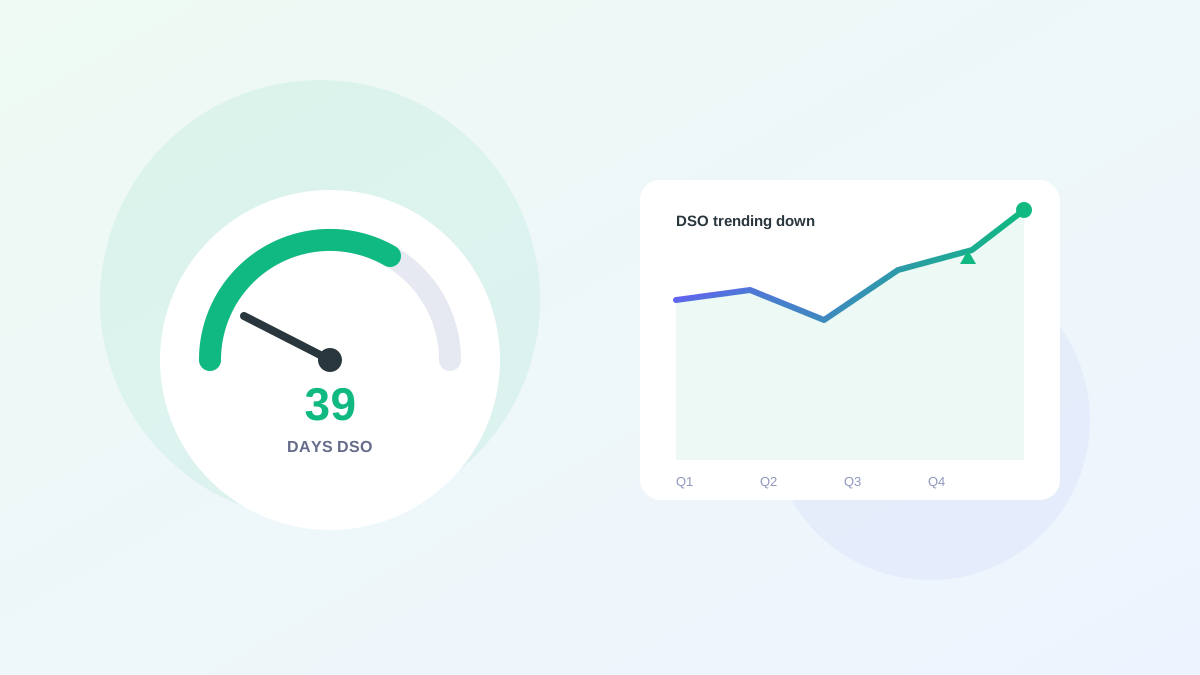
Benchmark against your own trend first and your industry second. A 2026 receivables benchmark put top performers near 39 days DSO with a touchless payment rate above 90 percent. The gap between your number and that figure is your opportunity, and it usually concentrates in a handful of customers and a handful of process steps.
1. Automate accounts receivable
This is the single biggest lever, which is why it comes first. Businesses that run AR manually carry an average DSO roughly 30 percent longer than those with moderate to high automation. The drag comes from slow invoicing, delayed cash application, and inconsistent follow-up, all of which automation removes.
AI-driven AR that issues invoices automatically, triggers collections workflows on schedule, and reconciles cash in real time typically cuts DSO by 15 to 30 days within the first 90 days of operation. That is a fast, measurable return that funds the rest of your improvements.
2. Invoice immediately and accurately
Every day between fulfillment and invoice is a day added to DSO before the customer has even seen the bill. Issue the invoice the moment the order ships, ideally as an automated step triggered by the fulfillment event rather than a manual task someone remembers to do.
Accuracy matters as much as speed. Disputes caused by a wrong quantity or price are silent DSO killers because the payment clock keeps running while the customer waits for a corrected invoice. Getting the invoice right the first time removes an entire category of delay.
3. Make payment terms unambiguous
Put the terms on every invoice in plain language. The phrase 'Payment due within 30 days of invoice date' collects faster than 'Net 30' because it removes any room for interpretation. Small wording choices compound across thousands of invoices a year.
State the due date explicitly, name the accepted payment methods, and show where to send remittance detail. Clarity at the bottom of the invoice prevents confusion that would otherwise become a phone call and a week of delay.
4. Offer more ways to pay
Buyers pay faster when paying is easy. Companies that accept four or more payment methods see payment cycles 20 to 25 percent faster than those that only take checks or wire transfers. Adding ACH, card, and portal payment options removes friction at the exact moment a customer is ready to pay.
Payment flexibility also drives revenue. Research shows 74 percent of B2B buyers say they would purchase more if offered pay-by-invoice options, and 82 percent prefer vendors that offer net terms at checkout. Easier payment helps both collection speed and sales.
5. Apply cash faster
Unapplied cash inflates DSO even after the money has arrived, because the invoice still shows as open until the payment is matched to it. A payment that sits unapplied for a week adds a week to your DSO for no reason other than a processing delay.
Automating cash application so payments match to invoices within hours removes that artificial drag and makes your receivables data trustworthy enough to drive collections decisions. This single step often produces the most visible DSO improvement because it corrects a number that was overstated to begin with.
6 through 9: the cadence that sustains the gains
The remaining strategies are about discipline and visibility rather than any single tool. They keep the improvements from the first five levers from eroding over time.
Run a consistent collections cadence so reminders go out on schedule. Align credit terms with current customer risk so you are not extending generous terms to slow payers. Give every overdue invoice a clear owner so nothing falls between people. Review your metrics monthly so a slipping bucket surfaces before it ages into a write-off.
- Automate the collections cadence: teams that do routinely cut a week or more off DSO with no added headcount
- Tie credit terms to current customer risk, not last year's assessment
- Assign an owner to every aging bucket so nothing stalls
- Track DSO, collection effectiveness, and dispute rates monthly
A realistic timeline for improvement
DSO does not drop overnight, but it moves faster than most teams expect once cash application and collections are automated. In the first 30 days you clean up unapplied cash and start a consistent reminder cadence. By 60 days the invoicing and payment-method improvements are flowing through. By 90 days the combined effect of faster cash application and consistent collections shows up as a measurable drop in the headline number.
Set a target that reflects your starting point rather than a generic benchmark. A team starting at 65 days should aim for the low 50s in a quarter, not 39 days immediately. Sustainable improvement beats a one-time push that slides back the moment attention moves elsewhere.
Where Nudge fits
Alderstone's Nudge gives finance teams real-time receivables visibility and automated cash application without replacing the ERP. By matching payments and remittances quickly and surfacing aging in one workspace, it attacks the two biggest DSO drivers at once: slow cash application and late collections.
Because your ERP stays authoritative for balances, you get the working-capital benefit without a migration project. Pair Nudge with clean, prompt invoicing and the headline number moves within a single quarter.