Audit Trails and Controls for Automated Order-to-Cash
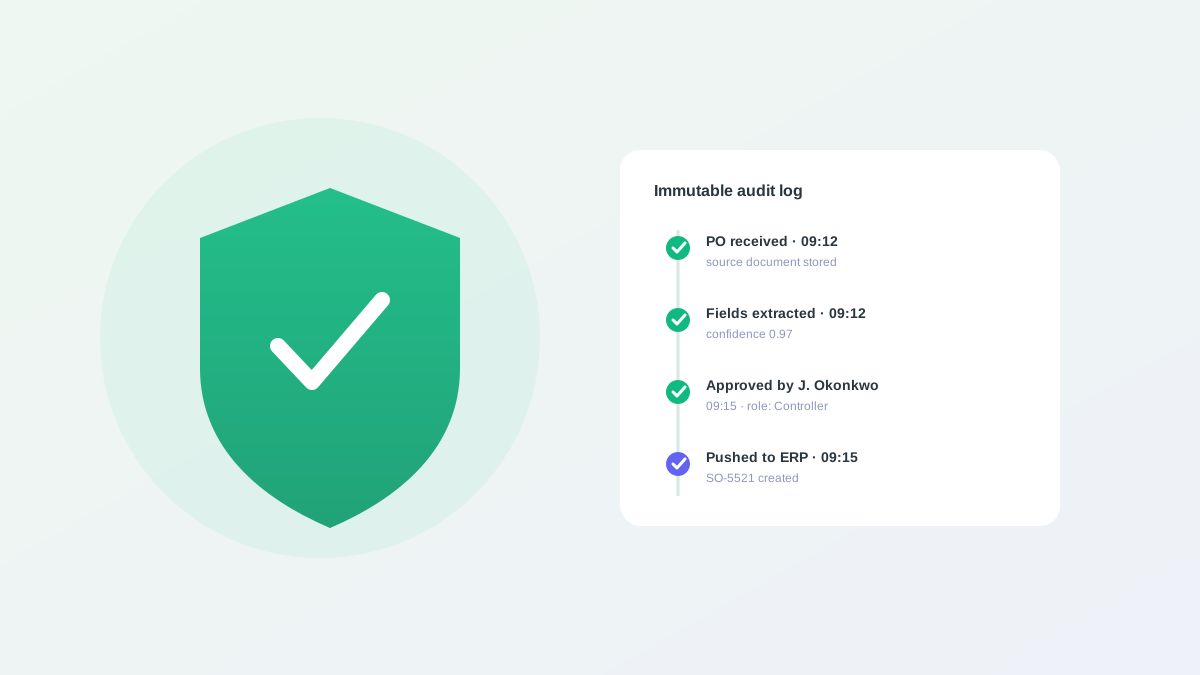
Automating order-to-cash raises an obvious question from finance, audit, and security teams: if a machine touched this order, how do we know what it did? For regulated companies, and for anyone selling into the enterprise, the answer cannot be a shrug. Auditability is what makes automation defensible in a SOX review or a customer due-diligence questionnaire. This article lays out the controls that turn an automated O2C process from a perceived risk into a genuine asset, and explains why a well-instrumented system produces better evidence than the manual process it replaces.
Why auditability is a prerequisite
Many buyers will not approve automation they cannot trace. Auditors need to see that controls operate consistently. Customers running vendor due diligence ask how automated decisions are governed and where the evidence lives. If your automation cannot produce that evidence on demand, it becomes a finding rather than an efficiency, and the project stalls in review.
The encouraging part is that automation, done well, produces stronger evidence than manual processes ever did. A human re-keying an order leaves no trail of what they read or changed. A well-instrumented system logs every transformation with a timestamp and an actor, so the record is more complete than the one it replaces.
What a complete audit trail captures
An audit trail for automated order intake should let anyone reconstruct exactly what happened to an order, from the document that arrived to the record that posted. Each step in the chain needs to be recorded in a way that cannot be quietly altered after the fact.
The completeness of this chain is what auditors test. A gap anywhere, such as an extracted value with no link to its source, weakens the whole trail, so the goal is an unbroken record from intake to ERP outcome.
- The original source document, retained immutably
- Every extracted field and its confidence score
- The validation rules applied and their results
- Who approved the order, with role and timestamp
- The ERP push outcome and the resulting record identifier
Preventive and detective controls
Beyond logging, automated O2C needs controls that prevent bad outcomes and controls that catch them. Segregation of duties prevents the same actor from both creating and approving an order. Guardrails block pushes that fail validation before they reach the ERP. Confidence thresholds ensure uncertain extractions get human eyes rather than advancing silently.
Duplicate detection prevents a re-sent PO from becoming a double order, which protects both the customer relationship and the accuracy of your books. Together these controls let automation accelerate the routine work while still stopping the exceptions, which is exactly the behavior an auditor wants to confirm.
Supporting SOX and customer due diligence
For SOX, the key is demonstrating that controls operate consistently and that evidence is retained for the required period. Automated logs make control testing faster because the evidence is already structured and queryable, so a control test becomes a report rather than a manual sampling exercise.
For customer audits, the ability to export the audit trail for a specific order or a date range turns a tense questionnaire into a quick attachment. You answer the question with the actual record instead of a written description of your process, which builds trust and shortens the security review that often gates a large deal.
Data retention and access
Auditability also depends on retention and access control. Source documents and logs need to be kept long enough to satisfy your regulatory and contractual obligations, and they need to be protected so the record stays trustworthy. Role-scoped access ensures people see only what their job requires, which matters when the same platform serves multiple entities.
Plan retention deliberately rather than keeping everything forever or purging too soon. The right window depends on your industry and your customer contracts, and the system should make it straightforward to apply that policy consistently across every order.
How OrderBridge logs every step
Every OrderBridge run retains the source PO, the extracted fields and their confidence scores, the validation results, the approver with role and timestamp, and the ERP push outcome. Audit events can be exported for compliance reviews and customer due diligence, and multi-company workspaces keep a central, exportable log across entities.
The result is automation your auditors and your largest customers can sign off on. The evidence is structured, complete, and available on demand, so the controls that govern your automated orders are easy to demonstrate rather than something you have to take on faith.