The Order-to-Cash Process: Steps, Bottlenecks, and Automation Opportunities
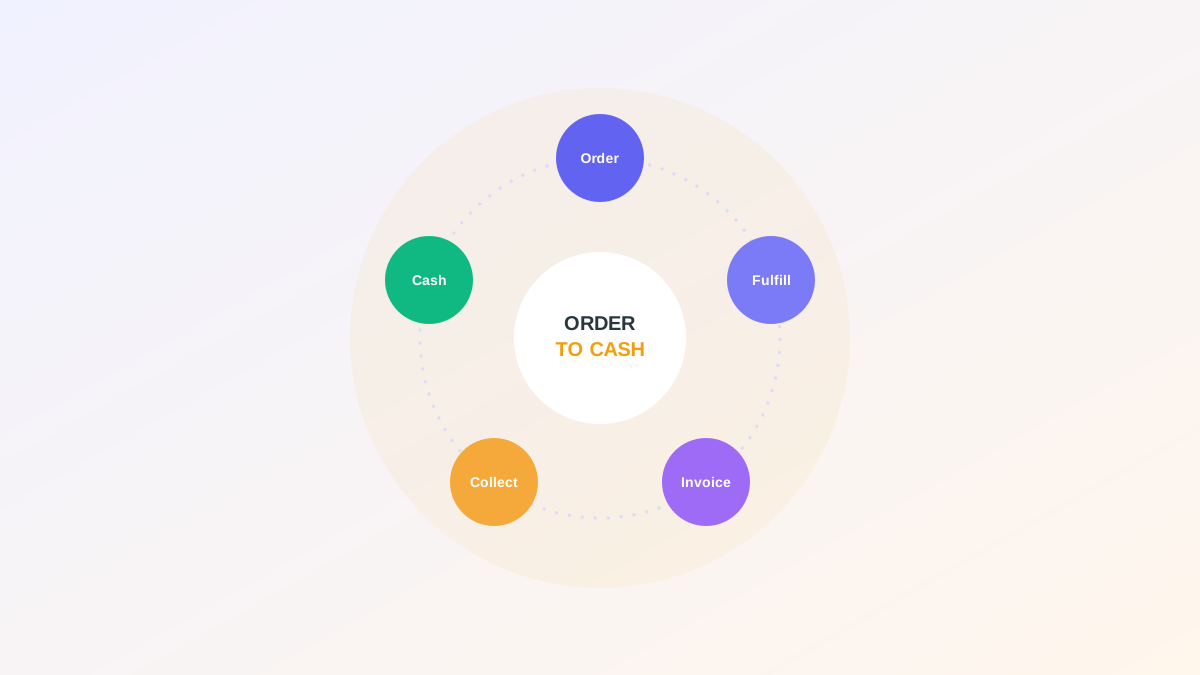
Order-to-cash, often shortened to O2C, is the end-to-end process that begins when a customer places an order and ends when you collect and apply the cash against it. It spans sales, operations, and finance, which is exactly why orders stall so easily at the handoffs between those teams. Each function does its part and passes the order along, and the gaps between them are where days disappear. Understanding the full cycle, and where it breaks, is the first step to fixing working capital and customer experience at the same time. This article walks through the seven stages, the bottlenecks that hurt most, and the steps that make the best automation candidates.
The seven stages of order-to-cash
Every O2C process moves through the same core stages, even when the tooling and the team names differ. Mapping your own process against this list quickly reveals where ownership is unclear and where data gets re-keyed from one system into another.
The stages are sequential, but they are not isolated. A weakness early in the cycle shows up as a problem later, which is why a single mistake at order capture can echo all the way through to collections.
- Order capture: receiving and recording the customer order
- Order management: validating pricing, credit, and availability
- Fulfillment: picking, shipping, and confirming delivery
- Invoicing: issuing an accurate invoice promptly
- Cash application: matching payments to invoices
- Collections: following up on overdue balances
- Reporting: tracking DSO, disputes, and aging
Where the process breaks down
The expensive bottlenecks almost always sit at the seams between stages. Order capture stalls when purchase orders arrive as PDFs and someone has to re-key them into the ERP. Invoicing slips when fulfillment data does not flow cleanly into billing. Cash application lags when remittance detail is separated from the payment it explains. Collections start late when the aging data is stale and nobody trusts it.
Each of these adds days to the cycle, and the customer feels the friction as errors and delays even when no single team is at fault. The order arrives late, the invoice is wrong, the payment is misapplied, and the relationship erodes a little with each handoff that goes badly.
The cost of a manual O2C cycle
Manual handoffs slow the cycle and introduce errors that ripple forward. A wrong quantity captured at order entry becomes a dispute at invoicing and then a short pay at cash application. The same mistake costs effort three times, and each correction adds delay.
PwC research shows that digitizing order processing alone can cut cycle times by up to 40 percent and processing costs between 30 and 50 percent, largely by removing the re-keying and rework that manual seams create. The labor is only part of the cost. A manual cycle also generates disputes, delayed cash, and lost customer goodwill that never show up on a cost-per-order line.
The best automation candidates
You do not have to automate the whole cycle to see results. The highest-leverage steps share three traits: high volume, structured-enough data, and validation rules clear enough to encode. Those are the steps where a machine adds the most value and carries the least risk.
Three steps stand out for most B2B operators. Each one sits at a seam where data is currently re-keyed or reconciled by hand.
- Order capture: AI extraction of POs into draft sales orders
- Cash application: automated matching of payments to invoices
- Collections: rules-based reminder cadences tied to live aging
Sequencing the automation
Order matters. Cash application is usually the best place to begin because it sits next to the ledger, carries low risk, and produces a visible DSO improvement quickly. Once cash application is reliable, the aging data it produces becomes trustworthy, which makes collections automation effective.
Order capture can run in parallel as a separate workstream because it touches a different team and a different part of the cycle. Trying to automate everything at once spreads attention too thin and makes it hard to attribute the results, so most teams stage the work over two or three quarters.
Automate on top of your ERP, not instead of it
A common and costly mistake is treating O2C improvement as an ERP replacement project. Migrations are slow, expensive, and risky, and they rarely fix the workflow problems that actually hurt, because most O2C pain lives at the edges of the ERP rather than in its core. The manual steps before data enters the ERP and after cash arrives are where the days disappear.
The pragmatic path keeps the ERP as the system of record and layers automation onto the intake and cash steps around it. Alderstone is built for this model. OrderBridge automates order capture and Nudge automates cash application and collections, both writing back to your existing ERP through a shared connector layer, so you shrink the cycle without betting the business on a migration.